Driver's position
Retractor and upper anchorage on the driver's side, buckle stalk toward the centre console. Height-adjustable upper anchorages are common. Often the most heavily cycled belt in the vehicle.
Category 01 — Passenger Vehicles
What a passenger car restraint is made of, how seating positions differ, what compatibility really depends on, and how to tell when a belt needs professional attention.
01 — Purpose and function
The purpose of a seat belt in a passenger vehicle is to keep the occupant connected to the seat and to control how that occupant moves when the vehicle's speed changes suddenly. Without a restraint, a person continues travelling at the vehicle's previous speed until something stops them — the steering wheel, the dashboard, a window or another occupant.
A correctly worn belt does three things at once. It holds the body against the seat so it does not travel forward unrestrained. It directs load into the pelvis and rib cage, which are better able to carry it than soft tissue. And it keeps the occupant positioned where the vehicle's other safety systems expect them to be — which matters because airbags and interior structures are designed around a belted occupant, not an unbelted one.
That last point is often overlooked. A modern car's restraint systems are engineered as a set. The belt is not an alternative to an airbag; it is the component that makes the airbag work as intended.
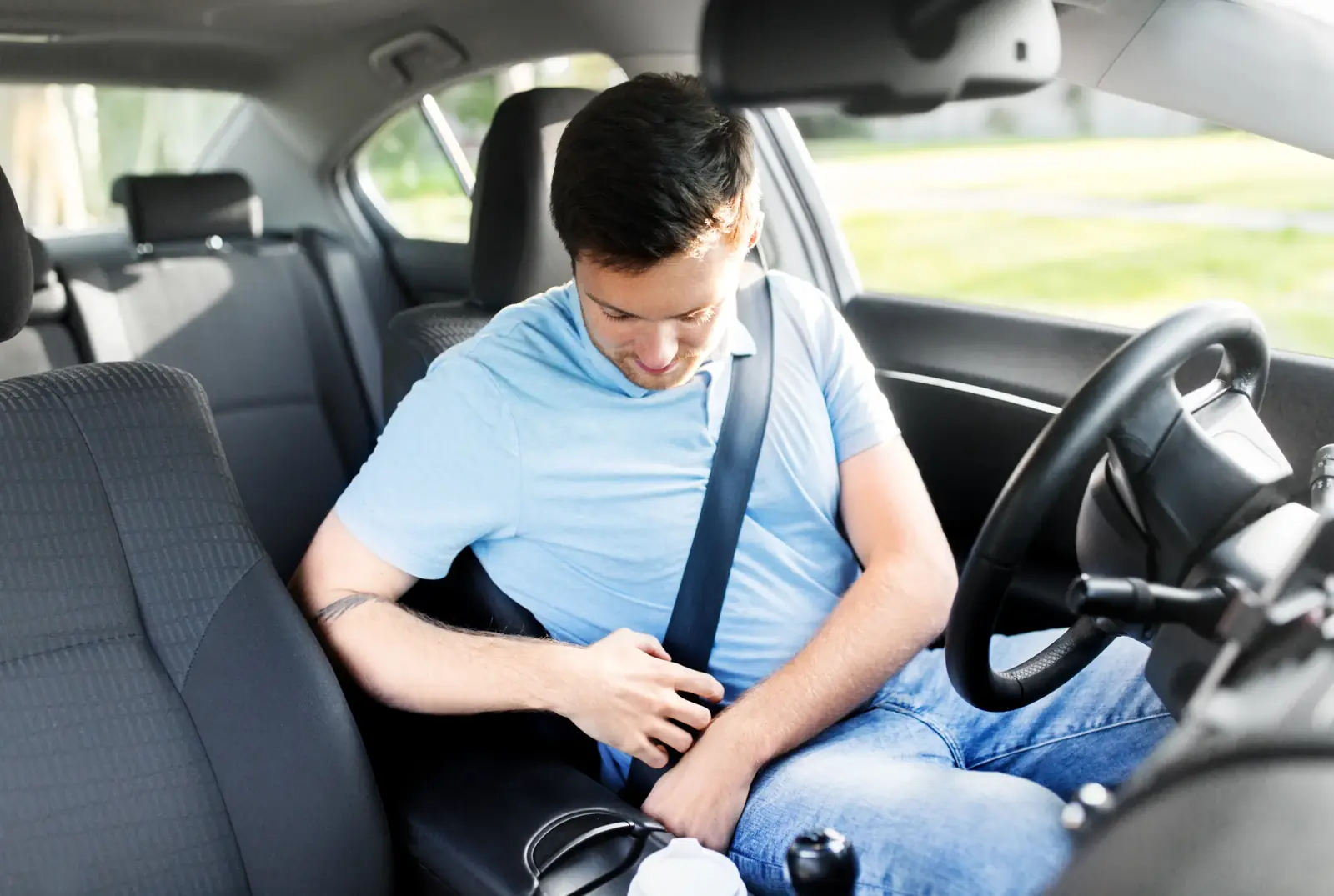 Three-point belt in use
02 — Belt configurations
Configuration refers to how many points the assembly anchors at and how the webbing crosses the occupant. In passenger vehicles you will mainly encounter two.
The familiar arrangement: webbing runs from a lower anchorage across the lap, up diagonally across the torso, and over the shoulder to an upper anchorage, with the buckle on the third point beside the seat. A sliding tongue lets one continuous length of webbing serve both the lap and shoulder sections, which is what allows the belt to adjust to different body sizes as it is put on.
Webbing anchors either side of the seat and crosses the pelvis only. In passenger vehicles these are most often found in centre-rear positions on older or simpler models. Where a vehicle was designed with a lap belt in a particular position, that is the specification for that position.
Most modern car belts are retractable: unused webbing is stored on a spool, slack is taken up automatically, and the mechanism locks under defined conditions. Static belts, adjusted manually to length, still appear in some applications. Many vehicles also offer a switchable retractor mode used when installing a child restraint — how that works varies by vehicle, and the handbook is the authority.
03 — Components
A passenger vehicle belt assembly is a set of matched parts. Understanding what each does makes it far easier to describe a fault accurately.
Each of these is dimensioned for the vehicle it belongs to. That is the practical reason belt assemblies are not generic: the parts are ordinary in principle and specific in detail.
04 — Seating positions
Position is not a detail — it determines the specification. A single vehicle can carry four or five distinct belt assemblies, none of them interchangeable.
Retractor and upper anchorage on the driver's side, buckle stalk toward the centre console. Height-adjustable upper anchorages are common. Often the most heavily cycled belt in the vehicle.
Mirrors the driver's belt, but as a distinct left- or right-hand part. Webbing lengths and stalk arrangements frequently differ because of seat travel and console shape.
Usually three-point, with the retractor mounted in the pillar, parcel shelf area or seat structure. Shorter webbing runs and different anchorage geometry than the front.
The most variable position of all. Depending on the vehicle it may be a three-point belt routed from the roof or seat back, or a two-point lap belt. Always confirmed against the specific vehicle.
In MPVs and larger SUVs, third-row belts have their own routing, anchorage and often folding-seat interactions. They are rarely shared with any other row.
05 — Vehicle compatibility
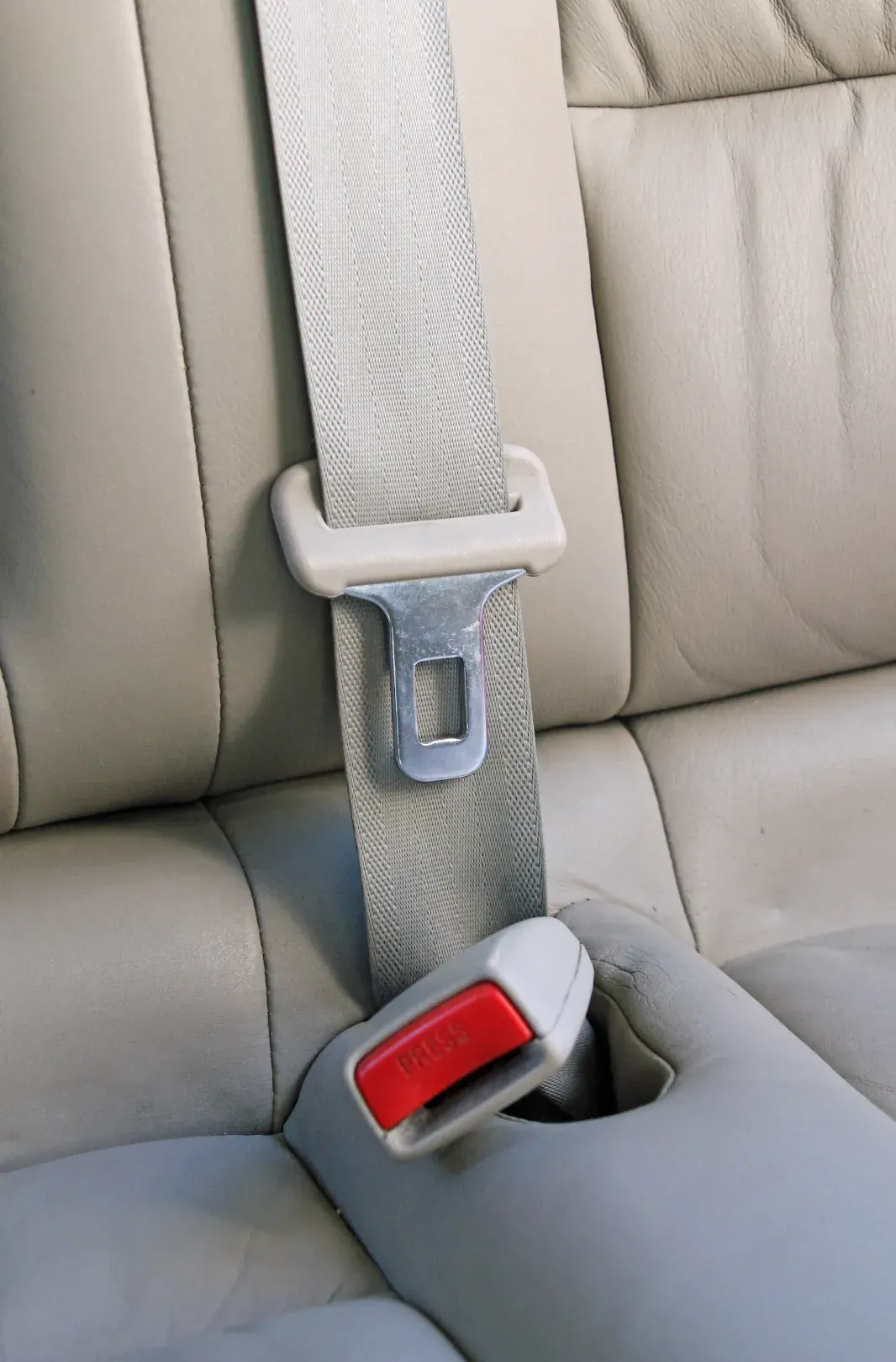 Webbing run · Buckle position
Two belts can look identical and still belong in entirely different vehicles. Compatibility is decided by a set of dimensions and design choices that are rarely visible at a glance:
Because of this, "it fits" is not the same as "it belongs". The only reliable route is to identify the correct part for the vehicle and seating position, and to have fitment carried out by a qualified automotive professional.
06 — Inspection awareness
You do not need specialist equipment to notice most seat belt faults — you need to look. These are the observations that should lead to a professional inspection rather than a shrug.
07 — Maintenance
Seat belts need very little maintenance, and most of the harm done to them comes from well-intentioned effort in the wrong direction.
Your vehicle handbook may set out specific cleaning and inspection guidance for your model. Where it does, that takes precedence over general advice.
08 — Replacement
A seat belt is consumable safety equipment. There is a point at which inspection stops being enough and the assembly, or part of it, needs to be replaced. Common situations include visible damage to the webbing, a buckle or retractor that no longer works reliably, corrosion or damage at anchorage points, and use during a collision.
Two principles apply throughout. First, the replacement must be correct for the vehicle and the seating position — not merely similar. Second, installation is a qualified job: anchorage points, torque figures and routing follow the vehicle manufacturer's specification, and getting them wrong undermines the very thing you are trying to fix.
09 — Enquiry guidance
For an automotive seat belt enquiry, the following will usually get you a direct answer rather than a series of clarifying questions:
10 — Questions
Front and outer rear seating positions in modern passenger cars generally use a three-point belt with a retractor: a lap section and a diagonal shoulder section anchored at three points. Centre rear positions vary — some vehicles use a three-point belt, others a two-point lap belt — so the vehicle itself decides rather than the class of car.
Not necessarily. Restraint hardware can change between model years, variants and even production batches, and left-hand and right-hand assemblies are distinct parts. Confirming the exact variant and year, and checking any part markings on the existing belt, is more reliable than matching by model name.
They should not be treated as interchangeable. Webbing length, stalk type, retractor design, bolt sizes and mounting geometry are specified for a particular seat and anchorage layout. A part that can physically be bolted into another position is not automatically the part intended for it.
A brief visual and functional check is sensible as part of routine vehicle care — look at the webbing, latch and release the buckle, and watch the retractor take up slack. Beyond that, follow the inspection points in your vehicle handbook and service schedule, and arrange a professional inspection whenever something looks or feels wrong.
A belt that carried load in a collision may have been stressed in ways that are not visible, and many vehicle manufacturers set out specific post-collision requirements for restraint components. After any accident, the assembly should be assessed by a qualified automotive professional working to the vehicle manufacturer’s guidance.
That is normal behaviour for most retractors, which are designed to lock when webbing is withdrawn suddenly, when the vehicle decelerates sharply, or both. Easing the belt back onto the spool and drawing it out smoothly usually releases it. If a belt locks unpredictably during normal use, or will not release, it needs professional attention.
Passenger Vehicle Enquiries
Give us the vehicle, the position and a photograph of the existing assembly, and we will work from there.