You want to understand the parts
The component guide covers webbing, tongues, buckles, retractors and anchorages, with the terminology people actually use.
Component guideQuestions & Answers
Twenty-five questions covering belt types, condition and inspection, compatibility and fitting, and how enquiries work — written to be useful rather than reassuring.
Start Here
Most enquiries follow a pattern: first what the parts are, then whether something is wrong, then whether a particular part will fit, and finally how to actually get one. The sections below follow that order.
Everything here is general information about seat belts and how they are used. It does not replace your vehicle manufacturer's handbook, professional inspection, or the regulations that apply where you drive.
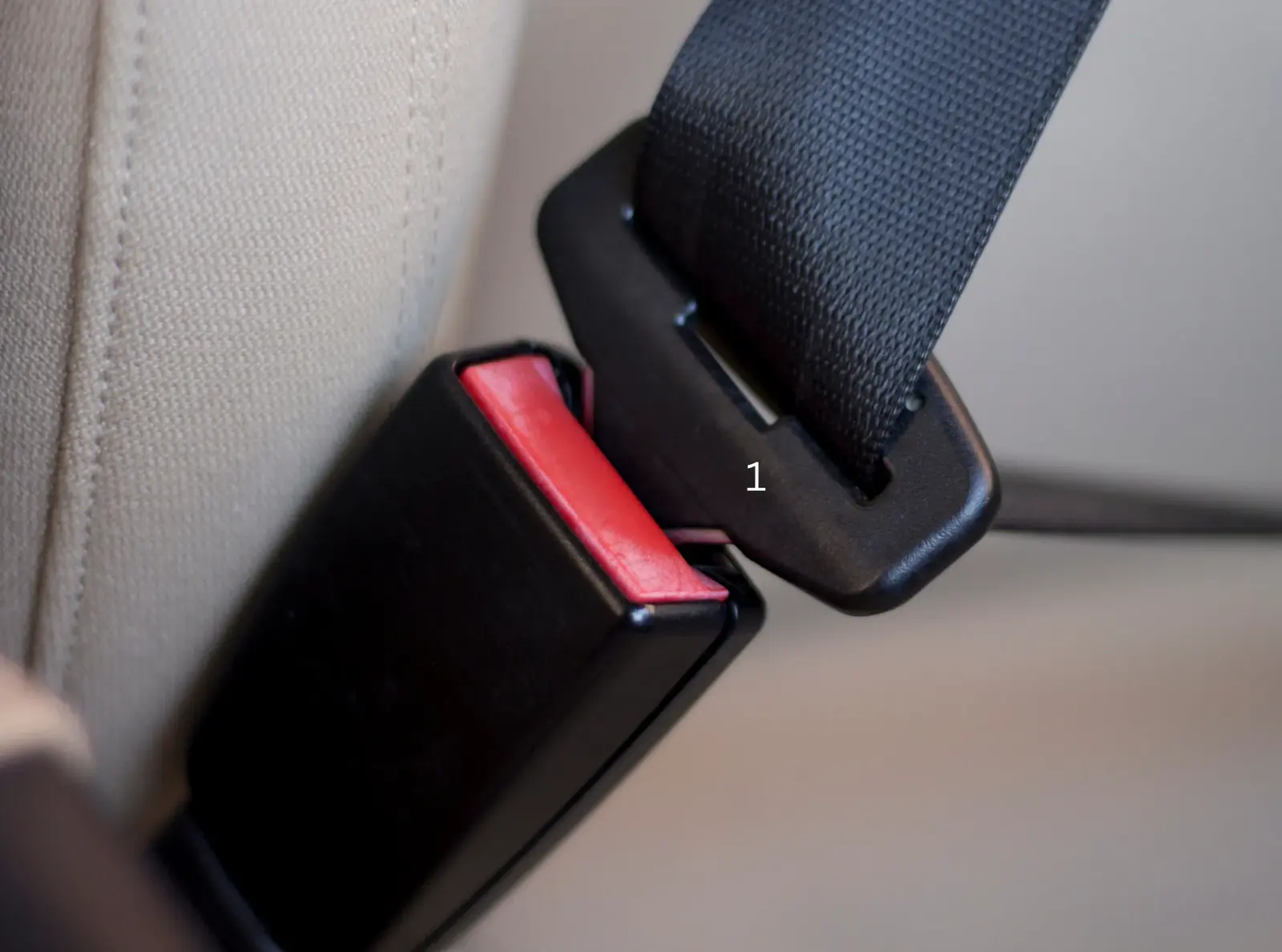 Buckle and tongue · Alignment
Belt types, what the parts are called and how a restraint works.
The two configurations you will encounter most are three-point belts and two-point lap belts. A three-point belt combines a lap section and a diagonal shoulder section anchored at three points, and is the usual arrangement for front and outer rear positions in modern passenger vehicles. A two-point lap belt anchors either side of the seat and restrains across the pelvis only; it still appears in some centre-rear positions, in certain buses and coaches, and in specific commercial and utility applications. Belts may also be static or retractable depending on whether webbing is adjusted manually or stored on a spool.
The difference is how many anchorage points carry the load and whether the upper body is restrained. A 2-point belt uses two anchorages and crosses the lap only. A 3-point belt adds a third anchorage and a diagonal section across the torso, so the belt restrains the pelvis and the upper body together. Because it holds the chest and shoulder as well, the 3-point arrangement keeps the occupant in a more predictable position — which is also what the vehicle’s other safety systems are designed around.
Webbing (the woven strap), the tongue or latch plate that engages the buckle, the buckle and its stalk, the retractor that stores webbing and manages slack, the upper anchorage or D-loop that guides the shoulder section, and the lower anchorages with their mounting hardware. Many modern belts also incorporate a pretensioner and load limiter, which are integrated with the vehicle’s restraint electronics.
It stores unused webbing on a spool, takes up slack so the belt sits close to the body, and locks the webbing when required. Locking is typically triggered by sudden vehicle deceleration, by rapid withdrawal of the webbing, or by both, depending on the design. Some vehicles also provide a switchable mode used when installing a child restraint — whether that exists, and how it is engaged, varies by vehicle.
That is normal behaviour for most retractors, which are designed to lock when webbing is drawn out suddenly. Easing the belt back onto the spool and pulling it out smoothly usually releases it. A belt that locks during ordinary movement, or that will not release at all, is a different matter and should be inspected by a qualified automotive professional.
No. Airbags are supplementary restraints — they are designed to work alongside a correctly worn seat belt, not instead of one. The belt keeps the occupant in the position the airbag and the vehicle’s interior were designed around. Consult your vehicle handbook for how the systems in your particular vehicle are intended to work together.
Spotting problems, knowing what to act on and what happens after a collision.
A brief visual and functional check is worth making part of routine vehicle care: look along the webbing, latch and release the buckle, and watch the retractor take up slack. Beyond that, a professional inspection is appropriate whenever something has changed — visible damage, a buckle that no longer latches or releases cleanly, a retractor that will not retract properly, movement at an anchorage, or after any collision. Your vehicle handbook and service schedule set out the checks specific to your vehicle.
No. Webbing is the component that carries the load, and damage reduces its ability to do that. Cuts, nicks, fraying, burn marks, heavy chemical staining, stiffening or significant fading are all reasons to stop relying on that belt and have the assembly assessed by a qualified automotive professional. Damage cannot be repaired by shortening, sewing or patching the webbing.
Three things. First, confirm that replacement is genuinely the answer — some symptoms come from twisted webbing or a trapped belt path rather than a failed component, which is what an inspection establishes. Second, identify the correct part for that specific vehicle, seating position and side, rather than something similar. Third, plan for installation by a qualified automotive professional working to the vehicle manufacturer’s anchorage and torque specification.
A belt that carried load during a collision may have been stressed in ways that are not visible, and where a pretensioner is fitted it may have deployed. Many vehicle manufacturers set out specific requirements covering restraint components after a collision. The correct step after any accident is to have the restraint system assessed by a qualified automotive professional following the vehicle manufacturer’s guidance — not to judge it by appearance.
There is no universal figure, and we do not publish one. Working life depends on how often the belt is cycled, what the webbing is exposed to, the environment the vehicle operates in and whether it has ever carried load. A belt in a hard-working commercial vehicle can reach the end of its useful life far sooner than one in a lightly used car. Condition-based inspection is far more meaningful than an assumed interval. Where your vehicle manufacturer specifies guidance for your model, follow it.
Yes, treat it as one. A buckle should accept the tongue with a clear, positive engagement and release cleanly at normal button pressure. Needing several attempts, holding the belt at an angle, or applying force are all signs the mechanism is not working as designed. Do not attempt to lubricate, clean out or disassemble a buckle — have it inspected by a qualified automotive professional.
Why parts are vehicle-specific, and who should install them.
Because a seat belt assembly is designed around the vehicle rather than the other way around. Webbing length, retractor type and orientation, stalk type and length, bolt sizes, mounting angles and any electrical provision all follow from the vehicle’s seat design and anchorage layout. Two belts can look identical and belong in entirely different vehicles. A part that can be bolted into a position is not automatically the part intended for it.
They should not be assumed to be. Even within the same model, left-hand and right-hand assemblies are distinct parts, rows are not interchangeable, and hardware can change between model years and variants. The reliable approach is to identify the correct component for the specific vehicle, seating position and side — using the VIN or existing part markings where available.
Because a seat belt transfers load into the vehicle structure, and whether it can do that depends entirely on how it is mounted. Anchorage points, fasteners, torque figures and belt routing are engineering requirements set by the vehicle manufacturer. A correct part installed incorrectly does not solve the problem it was bought to solve, which is why fitting is work for a qualified automotive professional.
We do not encourage it, and nothing on this website should be read as instruction to do so. Restraint systems are safety-critical, mounting requirements are vehicle-specific, and modern assemblies may be linked to pretensioners and restraint electronics. Have the work carried out by a qualified automotive professional following the vehicle manufacturer’s instructions and any regulations that apply where the vehicle is used.
This is not a parts swap. Adding a three-point belt requires a suitable upper anchorage in a structure designed to carry that load, so it is a structural and regulatory question rather than a purchasing one. It should only be considered with qualified automotive engineering input and in line with the regulations that apply to the vehicle.
A pretensioner removes slack from the webbing at the onset of a severe incident, and is usually paired with a load limiter that caps the peak force across the chest. It is linked to the vehicle’s restraint electronics and may contain energetic components, so it is subject to specific handling, fitting and disposal requirements. If your enquiry involves a pretensioner-equipped assembly, mention it — it changes both what can be discussed and who should carry out the work.
What to send us, what we can confirm and how trade enquiries are handled.
Vehicle make, model, variant and year — plus VIN or chassis number where you have it. The exact seating position, including which side. Whether you need a complete assembly or a single component. The quantity required. Clear photographs of the existing belt, buckle, retractor and mounting points. And any markings, labels or part numbers on the webbing or hardware. That combination usually allows an enquiry to be answered directly rather than through several rounds of questions.
Availability depends on the specific item, the quantity and the destination, so it is confirmed against your actual enquiry rather than stated in advance on this website. The product categories described here are the families commonly found in the market; whether a particular configuration can be supplied for a given vehicle is part of the conversation.
No — not as a blanket promise. Timelines depend on the item, quantity and destination, and a published figure that ignores those variables would be misleading. Timelines are discussed against your specific requirement during the enquiry.
Yes. Workshops, fleet operators and trade buyers are welcome, and grouped requirements are generally easier to work through than a series of individual ones. Include the vehicles or vehicle groups involved, the seating positions, the quantities for each, and whether the requirement is one-off or recurring.
We can help you understand what you are looking at and describe it accurately, and our guidance pages set out the signs that warrant attention. What we cannot do is assess the condition of a restraint in your vehicle from a distance — that requires physical inspection by a qualified automotive professional, and where that is the honest answer, it is the answer you will get.
No. We do not present claimed certifications, approval numbers or test results as website content, because a badge stripped of its context tells you very little. Where a specific product carries documentation, that documentation is discussed during the enquiry against the actual item.
By phone on +91 99206 38354, by email at info@autogleam.in, or through the enquiry form on the Contact page. The form asks for vehicle type and application because those details shape the answer more than anything else.
Not Answered Here?
Depending on what you are trying to resolve, one of these is probably the faster route.
The component guide covers webbing, tongues, buckles, retractors and anchorages, with the terminology people actually use.
Component guideThe replacement page lists the signs that warrant professional inspection and explains what happens after a collision.
Replacement guidanceSend the vehicle, the seating position and the quantity. If more is needed, we will ask for exactly that.
Contact usAsk Directly
Ask it in your own words. Describing what you are seeing works better than trying to name the part.